The original kenpo salutation can be traced all the way back to the boxer rebellion in China. At that time, the salutation was used as a gesture to demonstrate that one was fighting to bring back the Ming dynasty; with the left hand over right fist representing the sun and the moon. In Chinese (Mandarin), these two characters combined represented the symbol of the Ming dynasty. The emperor of both the sun and the moon. Essentially, the emperor everything. But this was the shorter version of the fuller salutation.

The complete original salutation is what we now use as the first half of the full salutation in American Kenpo.
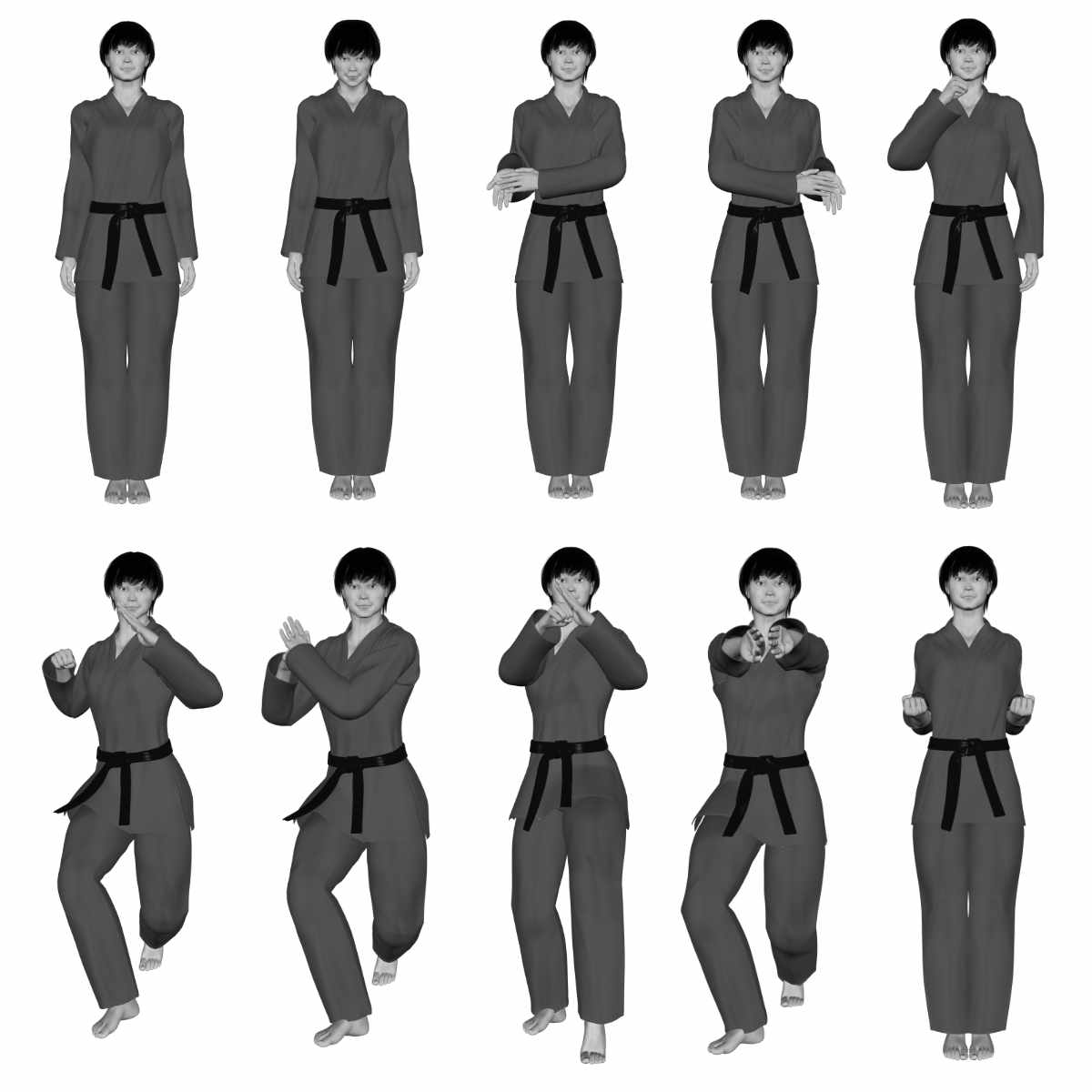
Rather that completely drop or replace the original salutation, SGM Parker decided to maintain an homage to the past and build upon it, just as American Kenpo is built upon its past roots. This change was to denote a continuation of the modern martial arts from those of the past. These new motions were appended to end of the original gestures, to keep them fully intact and to demonstrate the modern progressing from the past.
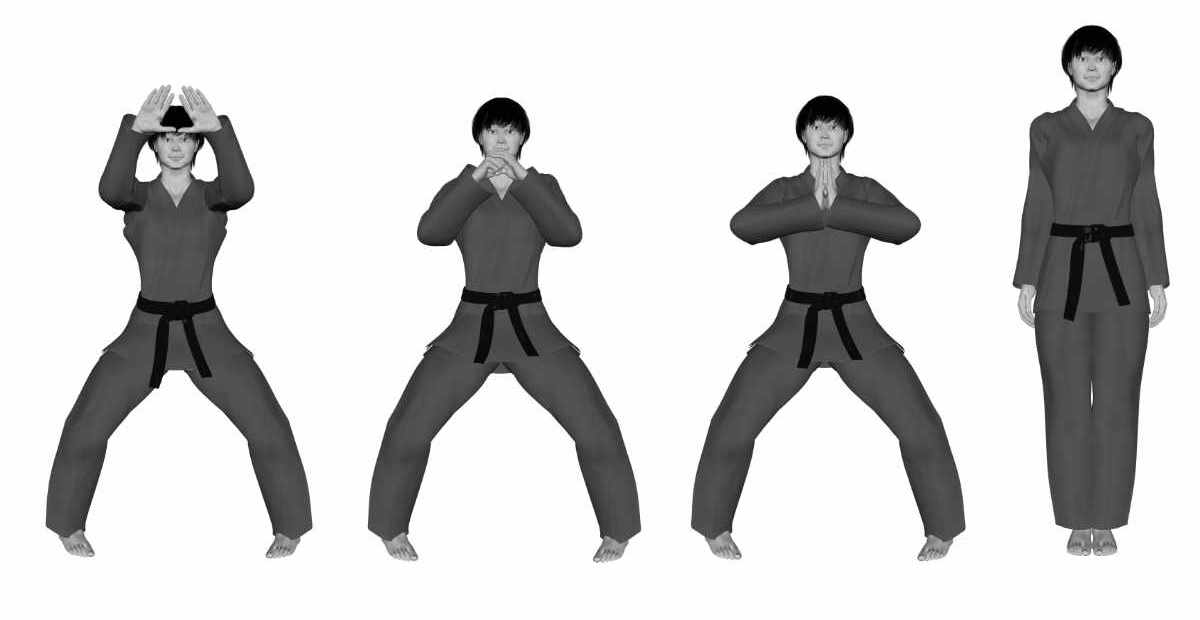
This combined series of movements is what modern American Kenpoists call their full salutation.
The interesting thing about Form Five, as it relates to the salutation, is that the salutation is integrated to be nearly part of the form itself. Unlike the previous forms, Form Five's salutation never finishes. Rather, the final attention stance (as visually illustrated above) is never executed. Instead, the form starts from the final praying-like position, just prior to the close to attention.
The reason for this practice is three (3) fold:
The first reason has to do with the themes of Form Five. One of the major themes of this form is being "out of position". What this means in practice is that the final maneuver of any self-defense sequence will purposely place the practitioner in a position that make transitioning to the next self-defense sequence relatively awkward. In other words, each series purposely ends "out of position" for the following series. This theme also holds true for the salutation and the transition into the first self-defense sequence. Instead of rising to an attention stance (i.e. finishing the salutation) and then dropping back into a meditating horse stance to begin the form, the form begins from the praying-like position of the salutation. This shortcut not only removes the unnecessary transition through the attention stance and back into the horse stance, but also places the parrying hand (i.e. the right hand) of the first self-defense sequence behind the covering hand (i.e. the left hand) of the first self-defense technique (Destructive Fans) prior to start of the maneuver sequence. This positioning has the left hand obstructing the line-of-sight for the first maneuver of the right hand, forcing a transitional maneuver (i.e. the horizontal spinning of both hands counter-clockwise), in order to successfully execute the initial maneuver. And thus, this positioning adheres to the "out of position" theme of the form.
The second major reason for this salutation alteration has to do with the inter-form theme of integrating the salutation further into the form itself. This theme started in Form Four and continues to manifest itself in Form Five. And, whereas the salutation integration was at the end of Form Four, it is now at the beginning of Form Five (i.e. opposites). The basic premise of this inter-form theme is to demonstrate that even the salutation can be used for self-defense with the proper positioning, but also that the salutation can be part of the form itself. This is demonstrated in different ways in both Form Four and Form Five. This practice is done to highlight the fact that the maneuvers of the salutation can have more overall meaning than just as a salutation; and simultaneously demonstrates that even typically ceremonial maneuvers can be integrated into martial application, under the right circumstances.
The third major reason for this alteration is the classification of the forms. The first set of forms (the ones and the twos) are commonly classified as the dictionary forms - because they primarily define motion. The next set of forms (the threes and four) are commonly classified as the encyclopedic forms - because the further explore motion beyond definitional terms. And, the final set of forms (five and above) are commonly classified as the extension forms - because they primarily concentrate of concepts that are special in nature.
Form Five highlights this new delineation between classifications (encyclopedic to extension) by altering the forms beginnings in the same way as was done between the dictionary and encyclopedic classifications - by altering the starting position. And, although Form Five does technically fall into a new form classification, it can also just be thought of as just an extension to the encyclopedic forms.
The one thing to note about this new classification of form (extension) is that there is no defined starting position. This is a departure from this tradition, up to this point. To be more specific; the dictionary forms always started from a horse stance and the encyclopedic forms always started from an attention stance. Starting with Form Five, this precedent no longer applies. In other works, all the extension forms start from different starting positions - not the same starting position.
Finally, to highlight the theme that the salutation can be integrated into the form itself, the reader should note that this book purposely integrates the signification and salutation maneuvers into the main form illustrations. This is done in contrast to earlier books where these maneuvers were broken out into their own separate subsection.