The subject of execution style can loosely be defined as the manner in which a form is carried out. Another way to look at this topic is: In what context is the form being performed? Or yet another is, for whom is the form being executed? This issue is important because it highlights the fact that the form can be performed differently under different scenarios and circumstances. And this matters a great deal.
This is important because the intent of the execution and/or the context of the performance can dramatically alter how the form is not only performed, but how it is received and perceived; and what that performance conveys to any observers. For example, performing the form within a testing environment would most assuredly be different from a tournament atmosphere. Furthermore, the performance of the form would also be viewed and scrutinized differently within each setting by any observers.
Given these differing scenarios, what can be determined is that the execution of any form can typically be broken down into two (2) major categories: idealized and stylized. Idealized being the true "standard" execution of the form; and stylized being a more personal or customized execution of the form. In stylized execution; modifications, personalization, and enhancements would be readily anticipated and accepted. As opposed to an idealized execution, where anything other than the "standard" execution would be far less tolerable. Another way to view these two (2) categories is: formal vs informal.
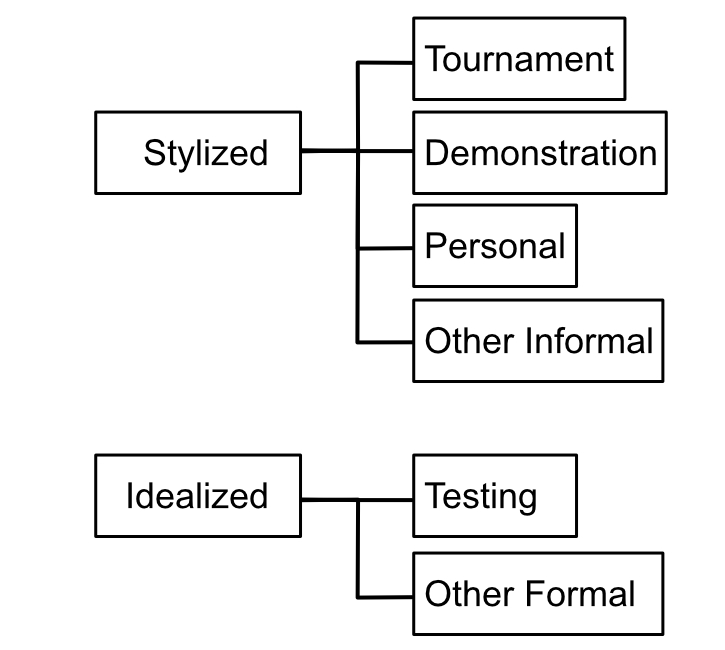
Execution Style
Idealized execution would be considered a formal execution of the form. This style exemplifies a stricter execution of the form. Another way to look at it is that the idealized style is the way the form "should" be executed - without any modifications and in a manner an American Kenpo purist would anticipate. In other words, performed in an ideal or "standard" manner. The anticipated audience would usually be individuals with knowledge of the form and the system. And, the execution would be performed to elicit a positive response in regards to "correctness" and proper execution, from a knowledgeable American Kenpo observer's perspective. This adept could be an instructor, a testing board, peers, or others within the system.
Stylized execution would be considered a non-formal execution of the form. Or, any other type of execution that is not idealized. This covers all the remaining potential scenarios. The major difference between these two (2) styles lies in the fact that personal modifications, preferences, and tastes influence the execution of the form in the stylized version; but not the idealized. And in the stylized rendition, the execution might be tailored to create a positive response to other martial artists outside the system, or just an audience of non-martial artists. Regardless of the audience, the performance is just that, a performance.
So, why is a discussion about execution style important enough to get its own section in this guide? Because stylized execution can sometimes mutate into idealized execution. This may be inadvertent or purposeful, but once this is done it can permanently change a form, in respects to that practitioner and their lineage; and potentially even the system. Because of this issue, one should always remain aware of these two (2) categories of execution and cognizant of which one they are performing; while remaining fully capable of performing the form in either way.
In summary, one should, and is encouraged to use stylized execution for exploration, personalized performance enhancement, or simply for enhanced viewer enjoyment. But one should never confuse these two (2) distinctive types of performances. The practitioner should always remain aware of the differences and purpose of each form of execution. And, never fold stylized execution modifications back into the "standard" execution of the form. Otherwise, the warnings spelled out in this guide will most assuredly begin to take root and spread. And, inadvertently morph stylized execution into idealized. Doing so would create lineage divisions within American Kenpo as to "standard" execution; and potentially change the information that was originally intended to be conveyed by the system.
Finally, keep in mind that this guide concentrates on the idealized category of execution. It does not delve into the stylized aspects of execution. This is mainly because this manner of execution is not the intention of these guides. Rather, their intention is to provide and preserve a deeper understanding to the "standard" execution of the form. Therefore, it is left up to the reader to further explore the stylized manner of execution through other avenues.