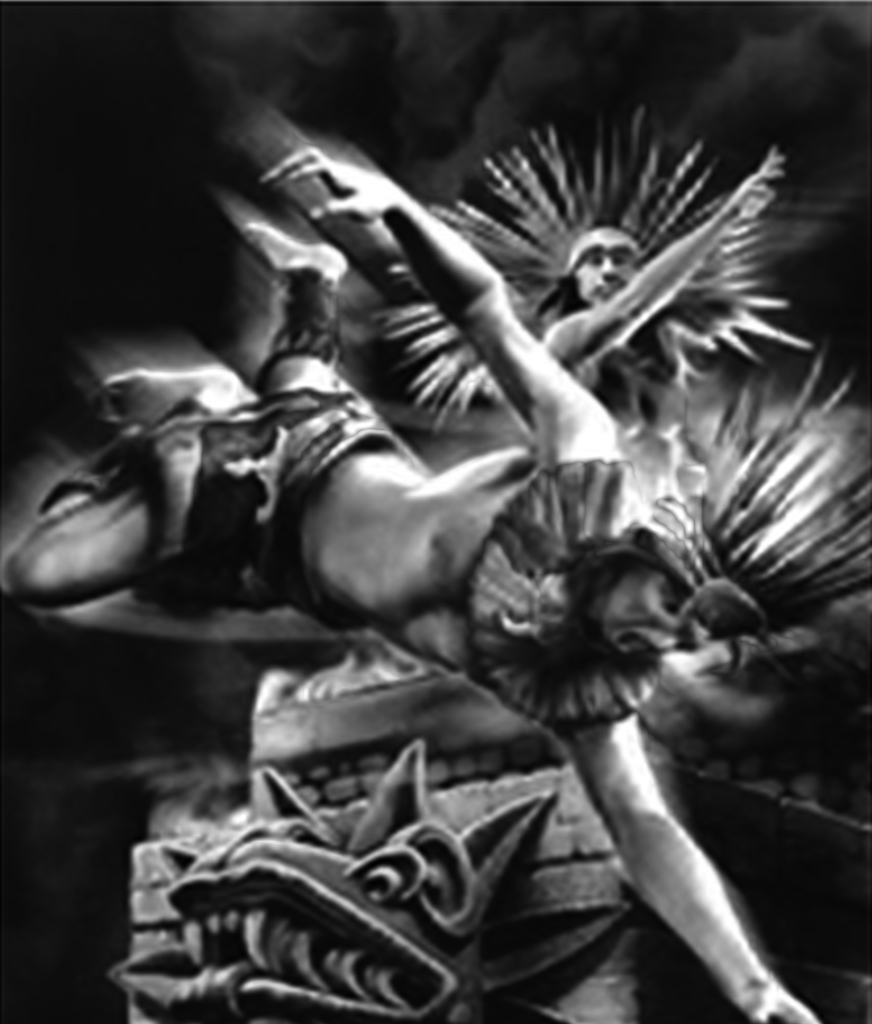
Undoubtedly among of the most commonly referenced rules in American Kenpo is Rule #1 - establish a base. This rule basically implies that the practitioner should get and keep a good base as often as possible. This is because a good base allows for proper alignments and bracing angles; along with balance, maneuverability, stability, and defend-ability. Also, without a good base, generating effective power for both offensive and defensive purposes become a far more challenging proposition. So, if Rule #1 is so important, why would one purposely give up a good base for something like leaping into the air?
But, before discussing why one would purposely leave the ground, it is important to review why it is mostly not a good idea. The first thing to consider is that during the period of time that one is in the air they have no base. Because of this, it is much easier to manipulate the position of the body and therefore reposition it to a point where re-establishing the base is no longer an option. In other words, it is relatively easy to turn an intended airborne maneuver into an unexpected fall.
The next thing to consider is the old adage: what goes up must come down. What this means is that if one leaves the ground, it is a certainty that they will eventually make contact with the ground again. This creates an element of predictability: and predictability can be taken advantage of. So, the savvy opponent will use a situation like this to create leverage over their adversary. And, one of the easiest ways to do this is to not allow the opponent to re-contact the ground in the way they expect. This is typically done by direct manipulation of the body itself, like the previous instance, or by denying the opponent the ability to place their feet back onto the ground properly. In other words, just remove the ability of the airborne opponent to create a stable base again. This can be done in a number of ways, and is left up to the reader to explore on their own.
One final thing to consider is the limited ability to adapt to a changing environment while in the air. If anything unexpected happens while airborne, it is extremely difficult to make changes in direction, trajectory, or orientation during this period of time. Therefore, once one leaves the ground they are fully committed to the maneuver until such time that they are settled back onto the ground. This then harkens back to the first two (2) circumstances, both in answering why it is easier to manipulate the opponent and also take advantage of their predictability.
Let's now invert our initial, negative, analysis and now consider some positives for this same concept.
The first positive consideration is distance. Leaps, jumps, and hops are just another set of foot maneuvers to be added to one's repertoire of basics. And, like the other foot maneuvers of the system these are primarily executed to create or close distance (i.e. Control the Gap) as needed. Also just like the other foot maneuvers, travel distance varies based upon the specific characteristics of the applied maneuver. Some maneuvers are intended to cover shorter distances, and others longer distances.
But unlike the other foot maneuvers, the distance benefit of leaving the ground is that it allows for the capability of covering a vast array of distances, both short and long. This is because airborne maneuvers remove limitations of distance being directly tied to the lengths of our body parts; and instead transfers those limits to our musculature. In other words, we are able to travel as far as our muscles are able to propel us. This does not mean that we are required to travel far (or high) distances, only that the distance limits of the other foot maneuvers are no longer a factor when one leaves the ground. And, this can knowingly be used in our favor.
Strategically speaking, we can segue smoothly into a related factor that should also be considered: speed. Covering a larger amount of distance than is capable by the earthbound foot maneuvers can also lead to getting to the intended target quicker. Economizing potentially multiple foot maneuvers down to a single launching maneuver can most assuredly lead to less time to target, if executed properly. Timing, alignments, and speed can all be used in conjunction to deliver a potentially devastating strike, while not in a base. But like any skill, proper coordination of the elements is key to effectiveness.
And our final positive consideration for this discussion is: gravity. Gravity is a force in which we all live while on planet earth. And, just like any force, we can go with it or against it. Looked at slightly differently, we can either fight gravity or use it to our advantage. This precept is so prevalent in American Kenpo that we have named one of our three (3) power principles for it - Gravitational Marriage. In short, this term means to use gravity to help us in generating power; not as a hindrance to power.
Most typically, we consider using gravity while in a stance. We use downward (and upward) motions and alignments to take advantage of the pull of gravity; on both us and our opponent(s). But we can also use this constant potential energy to enhance downward strikes with our feet, both singularly and simultaneously. Except, in order to use both feet simultaneously, by definition, we have to leave the ground first. We have to give up our base completely.
In other words, we can take advantage of the adage of "what goes up must come down" we referenced above. We can use the re-establishing of our base to also deliver an offensive maneuver at the same time. This can be the primary purpose, such as to deliver a stomp, or as a secondary purpose; such as to crush whatever is below our feet as we land. Regardless, the general strategy is to take advantage of the downward pull of gravity in some way.
Seeing that there are a number of both negative and positive considerations for leaving the ground, we can now return to the question as to why one would purposely do this. To answer that query, one must first understand that any rule in American Kenpo also comes with a corollary to that rule: rules only need be obeyed 99% of the time. In other words, rules have exceptions. And, Rule #1 is no exception.
But instead of just applying the pros and cons to the 99% proposition, let's instead take a completely different approach. Let's ask the question; when is it generally safe to give up a good base and leave the ground? Or, when is it usually considered okay to not obey Rule #1? And to be fair, all situational propositions beyond this point are subjective. In other words, opinions will vary. It is left up to the reader to determine whether they consider any of these conditions enough reason to leave the ground or not. Regardless of opinion, it is highly recommended that the reader studies the circumstances that bring about the implementation of this tactic, for it may be used against you.
First, the surprise attack. Due to the distance and speed potentials of launching, one can quickly take the opponent by surprise; thus, potentially not allowing the opponent the opportunity to use any countermeasures against the committed aggression. This scenario can be closely associated with the American Kenpo adage: "closest available weapon to closest available target". Regardless of specific details, the overall tactic is the same: implement the aggression as quickly and effectively as possible, with the hope that the opponent won't be able to take advantage of the full commitment of the situation and flip it to their favor. The risks are high, but so to may be the rewards.
Next, minute or extremely short periods of time. These situations are most closely related to the concepts of Body English, Directional Harmony, and Confluence of Forces. The implementation of this stratagem is typically executed through the lifting of the feet to quickly settle into a lower stance for the purpose of enhancing a vertically downward striking maneuver. Or conversely, to launch slightly forward for the purpose of enhancing a horizontal striking maneuver. In both circumstances, the general idea behind this methodology is to provide the back-up mass of the entire body weight to amplify the effect of the executed strike. And, doing so through the use of quick and compact augmenting maneuvers.
Because of this specialized use of such condensed maneuvering, the length of time that the practitioner is actually airborne is negligible; yet the increase in potential power generation is great. Furthermore, because of the highly subtle nature of these maneuvers; precise coordination, proper execution, and meticulous timing are critical to creating the desired outcome. And as implied, the risk of the opponent(s) taking advantage of the period of time that there is no base is minimized almost to the point of not being a factor. In other words, big potential reward with minimal risk.
Finally, and probably the most common practice is to use leverage to conceal or allow for our temporary purposeful disadvantage. This specific tack also has the most wide-ranging scenarios and it can cover a large number of situations. But generally speaking, this approach can be better described as setting up or recognizing a setting where the position of you, your opponent, or both of you is such that the risk of giving up your base and leaving the ground is minimized.
As stated previously, there are a number of situations that would qualify to employ this tactic. Some simple examples of this are: you are in the Obscure Zone of an opponent (i.e. they can't see you properly), the ability of the opponent to move to reach you effectively is compromised (e.g. they are in a compromised stance, lying on the ground, and/or at a safe distance), or the opponent is distracted (e.g. they are looking away, not paying attention, preoccupied, or otherwise engaged by a prior strike or maneuver).
Of these samples, there is one situation that we will expand upon a little further: the scenario where the opponent is lying on the ground. The main reasons this scenario was chosen is because this specific context allows us ready access to using both the environment and positioning to our advantage; while also easily allowing for further examination of both the overall and specific subjects of this discussion. To contextualize this situation a little further, this position lends itself to the use of stomping strikes. And, more specifically for our analysis, the double stomp.
(For more information about stomping, refer to the section in this guide named "Appendix F - Vise-like Maneuvers".)
This individual strike was chosen because its specific characteristics easily open up the opportunity for a slightly more in-depth analysis of the subjects at hand; is a good and practical exemplar for including some of the other tactics mentioned above, and it follows most of the same rules as the single stomp; along with many other vise-like maneuvers.
First, a quick overview of the scenario in question is warranted. The best situation to use a double stomping strike is: when the opponent is face-down on the ground and also is within a relatively close distance to you. From a tactical standpoint, being behind the opponent: potentially places us within their obscure zone and may hinder and/or limit the opponent's ability to quickly maneuver. As mentioned earlier, the opponent lying on the ground allows us the opportunity to take advantage of the environment (i.e. the ground). The closeness of the opponent allows for us to use time and distance in our favor, by employing a shorter path of travel.
Next, a summary of some of the important rules to follow for the double stomp strike. The ones that concern us for this examination are:
1.a stomp should allow for proper path of travel of the strike by creating a gap 3x the height of the target being stomped (i.e. proper Path of Travel)
2.a stomp should not rely upon isolated back-up mass, but instead engage both the mass and speed of the striking weapons along with the entire mass of the body (i.e. proper Back-up Mass)
3.a stomp should create the proper alignments for the creation of proper weight transfer (i.e. an Angle of Incidence; not a glancing angle / Gravitational Marriage)
And finally, let's move onto a somewhat more holistic examination of how to use the above frameworks in the physical world. The purpose of this study will be to help us determine the appropriate employment of the concept of leaving the ground for this particular maneuver, aid us in determining proper execution of the strike from improper, and simultaneously provide us with a good example of how to use this same type of analysis in other situations.
Now, in order to better concentrate on the elements pertinent to this specific review, we will make the following assumption: we have examined the situation in question and have already determined that executing the double stomp strike is warranted. This is where the following considerations come into play.
Consideration #1: How far to travel.
Ideally, only enough as to be effective. In other words, as little as possible. This is why the scenario overview above states: "relatively close to you". Less travel means less time without a base. But realistically, our travel needs to be far enough to get proper alignment for the delivery of the strike. In this case, directly above the intended target(s). Also, a significant problem with a further path of travel is: the further the travel, the more elongated the trajectory path becomes; which may affect alignment and proper striking angle (i.e. Angle of Incidence). Too much of an elongated path may force the strike to create a glancing angle with the intended target(s), or potentially even disrupt our ability to re-establish a base.
Consideration #2: How high to leave the ground.
Again, only enough as to be effective. Keep in mind that the higher the travel, the longer time without a base. This factor is generally considered the same as distance of travel. Also, the rule that generally dictates a minimum height is the 3x rule listed above.
But, vertical Path of Travel has a unique characteristic that doesn't apply to distance of travel. Our stance already places our body a certain distance above the ground, This is important because if our body is already 3x the height of the intended target(s) or higher, this means we don't have to raise our body any higher than it already is. In other words, we don't have to leap up into the air because we are already at the needed height.
In practice, this means that all we need to do is raise our striking weapons (e.g. our feet) to the proper height, not our entire body. To accomplish this, we just need to raise our feet off the ground and then return them onto the target(s). A simple adage that may help one understand this a little better is: "bring your knees to your chest, don't leap into the air".
One other thing to consider about this specific methodology is that your body begins to immediately fall downward because of the pull of gravity. Therefore, you don't have to first raise the body upward and then wait for it to begin to drop downward again before the strike can be delivered. This is a simple, but often overlooked, way to cut down on the time without a stance.
Consideration #3: How to execute the strike.
Working from the previous consideration; one should not rely only upon the downward travel of the body to deliver the strike. Instead, the legs should be used to increase the speed of delivery of the strike. In other words, use the downward motion from the extension of the legs, for regulating speed of the strike; while also taking advantage of the downward momentum of the body to increase the mass of the strike. Thus, increasing total power output; and another way of decreasing time without a stance.
To be a little more detailed in our examination, let's consider the implied part of this consideration. It is that the proper use of the legs and body weight will be done with proper alignments for the strike. The adage that applies to this is: "alignment makes back-up mass possible".
One more thing to keep in mind about all this power generation is that you are using natural weapons; and natural weapons can be injured. So, take care in regulating the power as to not injure yourself upon impact of the strike. Also, pay attention to both the hardness of the ground (e.g. dirt vs rock / wood vs concrete) and the hardness of the target. And, this leads us directly into the final consideration.
Consideration #4: What target(s) to strike.
There is a general adage that can be used to help in this regard. It is: "match hardness of weapon to hardness of target". This means that one should fully understand what weapon should and should not be used against a specific target. What this adage does not necessarily mean is: a soft weapon to a hard target, and vice-versa. One needs to take the time to understand the factors involved in determining both weapon and appropriate target.
Secondarily, another thing to factor when choosing the target(s) is whether the target(s) will allow for easily creating a good stance again - or not. For instance, the head would probably not be a choice target, because it may roll upon impact and prevent us from creating a proper base again. Although, it might crush and we might be okay; but probably not. So, don't count on it.
A similar thing may happen if the center of the body is chosen. This brings up things like: how do we get back onto the ground; or do we establish our base on the opponent?
Because of this re-establishing a base problem, narrower targets and/or targets at the edge of the body would probably be best suited for this scenario. This will allow only the heel of the foot to be used to create contact with the target(s). Thus, allowing us to potentially re-establish a definite base with the balls of our feet. In this case, orientation is also a crucial element of the strike.
And alternatively, targets that may be easier to squish may prove to be a preferential choice over harder targets. Targets that will more easily compress with the application of our weight onto them. In simpler terms, flesh and organ targets over skeletal targets.
One final thought on this is subject: up to now we have only considered a natural environment. But the opponent could be wearing something that prevents, protects, or even exposes specific targets. In other words, man-made elements could play a vital role in any of our considerations. Also, the natural environment, or any environmental factor, might dictate that we must alter our plans or even abandon our initial strategy completely.
Environment is the most significant factor to consider and we should always be keenly aware of it, and include it in any tactical analysis. In fact, it is consideration #1. Put another way, the environment is always the most important consideration in any scenario. This fact may not seem obvious at first, but it is undeniably true.
In conclusion, the discourse presented here is not intended to be an all-encompassing overview of the subject of leaving the ground. Instead, it is hoped that this discussion not only presents the practitioner with a more in-depth insight into the subject; but also provides them with at least a fundamental ability to employ this new understanding in practice, no matter the circumstance: educational, competition, or combat.